
Berlin, May 11th, 2026
From Thermal Imaging to Outer Space
Case Study of Cliphit
When Ulf Rohbeck began processing infrared data under Windows in the late 1990s, even the loss-free storage of 30 frames per second represented a major technical challenge. The real difficulty, however, lay less in the camera itself than in the question of how such data could be captured, displayed and stored reliably over extended periods of time.
It was precisely from this challenge that Cliphit gradually developed, over many years, a software platform that is now used worldwide in industrial analysis, inspection and control systems.
The first application was based on an Intel Pentium III system equipped with a Matrox Meteor II and a RAID 0 array for data storage. The RAID system was not a matter of convenience, but a technical necessity in order to write the incoming data continuously. Only through the use of the Kithara real-time library was it possible to parallelize multiple threads under Windows 2000 with sufficient precision and process the infrared data loss-free at 30 hertz. In spring 2000, this solution was presented publicly for the first time at SPIE in Orlando.
As new camera systems emerged in the following years, the requirements changed as well. In the early 2000s, NEC San-ei introduced a FireWire interface into an infrared camera for the first time. This required a fundamental redesign of the software. By 2003, it had become possible to process infrared data loss-free on a notebook computer – at a time when mobile systems were hardly designed for such data rates. As a result, the focus gradually shifted from pure data acquisition toward practical applications under real operating conditions.
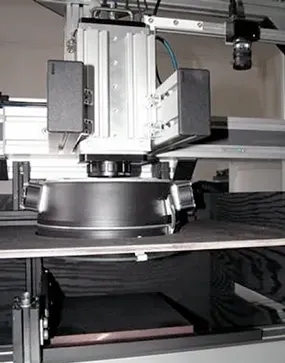
What had originally started as a single application gradually evolved into a modular platform. At first, “irMOTION collection” supported only a single camera system. Later, “irMOTION observer” introduced parallel operation of multiple cameras, PLC integration and the implementation of an EtherCAT master. What had once been a measurement application increasingly became a complete industrial system solution.
As system complexity increased, the actual challenges shifted as well. Data no longer only had to be processed quickly, but also reliably and deterministically. For a long time, analysis and database functions were executed directly within the data streams themselves. In practice, however, it soon became apparent that certain processing steps occasionally required more time than the actual transmission rate of the camera data. The result was delays in control and trigger signals.
For this reason, the internal software architecture was fundamentally redesigned. Analysis processes were decoupled using asynchronous callback mechanisms, data structures were moved into shared memory, and synchronization was handled through events. Only then did stable operation under high load conditions become possible. Today, this method forms the basis of nearly all data-processing operations within the software.
At the same time, time-critical components were gradually moved from user mode into kernel mode – first for Ethernet data reception, later also for EtherCAT communication. This transition did not happen in a single development step, but evolved over many years. Today, all relevant real-time processes run directly at kernel level and fulfill the requirements of continuous industrial 24/7 operation.
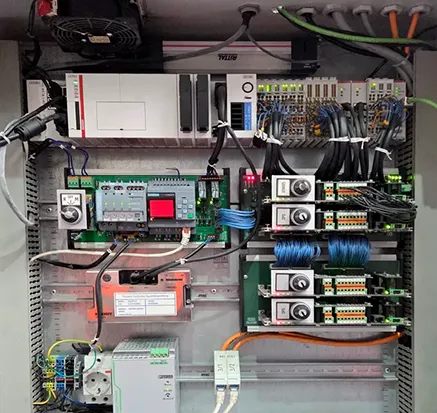
Modern embedded platforms were also integrated consistently throughout the system. Among other things, the software was optimized for Beckhoff CX20x2 systems and expanded with dedicated control cabinet modules. Additional interfaces such as the EtherCAT terminal EL6631-0010 enabled integration into Profinet systems. At the same time, another generation of cameras based on the GigE Vision standard was introduced. The corresponding routines for data reception and transformation were implemented close to the kernel layer from the very beginning – a clear indication of how strongly the overall architecture had become focused on deterministic behavior.
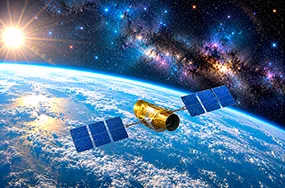
The fact that these concepts also proved themselves under particularly demanding conditions became evident early on in a space-related project for the German Aerospace Center (DLR). A simulator for so-called SpaceWire interfaces was developed – a communication system used in spacecraft for data exchange between onboard instruments and control systems.
The task was not merely to transmit data packets, but also to modify them deliberately, simulate fault conditions and test communication sequences under realistic conditions. The simulator therefore had to operate with exceptional stability and real-time capability. To ensure reliability, the system was additionally developed in both master and slave versions and intensively tested against itself before being deployed with actual aerospace components.
Among other applications, this technology was used in connection with the COROT satellite project for asteroseismology and exoplanet research. The successful rocket launch at the end of 2006 marked the visible culmination of a project in which stable and deterministic communication played a decisive role.
Cliphit also contributed its expertise to European research initiatives such as PROFIT and ZIM. These projects focused, among other things, on developing new methods for analyzing plastic mixtures. Plastic samples were heated in a controlled manner, their cooling behavior recorded using infrared cameras, and subsequently evaluated using specially developed algorithms. The resulting methods later became part of industrial quality-control and process-control applications.
Throughout all these years, the collaboration with Kithara played a central role. The two companies developed not only a close technical exchange, but also highly individual development support – often directly related to concrete problems arising in real-world applications. New requirements emerging from Cliphit projects repeatedly flowed directly into joint solution strategies and technical extensions.
Ulf Rohbeck describes it as follows: „There are situations in which an effect within the system is clearly visible, yet cannot be reproduced immediately. These are exactly the situations that drive development forward. Through close collaboration, solutions emerge that go far beyond the original problem.“
Today, the software supports up to four infrared cameras simultaneously, processes the data in real time, visualizes the results and communicates in parallel with higher-level control systems via EtherCAT or Profinet. The platform has been tested successfully over many months in industrial applications, operates stably and loss-free, and is used worldwide.
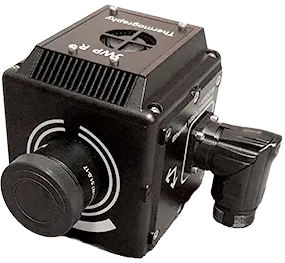
Since 1999, several hundred licenses have been delivered across a wide variety of industries – ranging from industrial manufacturing and application engineering to universities and research institutions.
Over the years, what began as a single application evolved into a versatile real-time platform. The next development step is already becoming visible: AI-based analysis methods are expected to play an increasingly important role in the future. Yet the foundation remains the same as it was from the very beginning – a software architecture consistently driven by real-world requirements and continuously refined over time.
Cliphit on the Internet: cliphit.de/